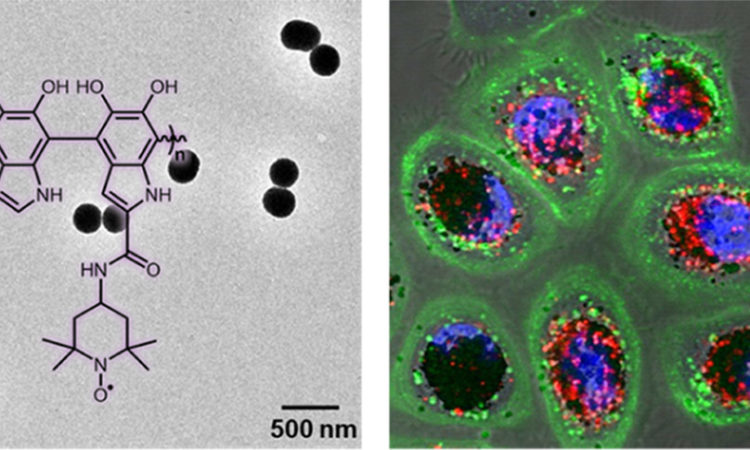
There’s a compound in your skin that protects you from UV radiation, tints peacock feathers iridescent blue without a single drop of blue pigment, and is found in deep-sea fish that have never once seen sunlight. It insulates. It colours. It absorbs. And somehow, chemists at Northwestern University have spent the last decade reverse-engineering it — and putting it back on your skin to help it heal.
That compound is melanin. And it’s a reasonable entry point into what nanomedicine actually looks like when it’s working.
Nathan Gianneschi, a professor of chemistry at Northwestern, has been working on synthetic melanin nanoparticles since around 2014. The premise is straightforward: melanin already exists in skin tissue and plays a role in how skin responds to damage. So what if you could make a topical version — precisely engineered at the nanoscale — and apply it externally to accelerate healing after burns or injury?
It turns out you can. His group has applied it to UV burns, chemical burns, and is now working on radiation dermatitis — the painful skin inflammation that develops in patients undergoing radiotherapy for cancer. That last one matters quite a bit, because currently there is no approved treatment for it. Patients simply endure it.
This is the part of nanomedicine that doesn’t always make it into press releases: it’s slow, cross-disciplinary, and usually starts with a chemist giving a talk in a dermatology department and two doctors walking up afterwards saying “have you thought about putting this on skin?” Most breakthroughs in translational science start roughly like that.
Gianneschi’s lab also works on something called proteomimetic polymers — synthetic molecules engineered to mimic the behaviour of proteins. Proteins, for context, do essentially everything in your body: they regulate, signal, build, and destroy. They’re also notoriously difficult to drug, particularly when their function depends on shape rather than chemistry.
These polymer systems behave differently from both small-molecule drugs and antibodies — they’re a different size, they circulate longer in the body, and they can access targets that conventional therapeutics can’t reach. Current focus areas include neurodegenerative diseases (Alzheimer’s, Parkinson’s, ALS) and retinal disease. A spinout company is working to bring some of these materials into clinical trials, particularly in oncology.
None of this is imminent. Gianneschi is fairly direct about that. The models for neurodegenerative disease take months to run. Some promising materials don’t dissolve properly. Some aggregate on the shelf. The distance between a fascinating lab result and something a nurse can reconstitute at point-of-care in forty-degree heat is, as he puts it, “a lot of hard work.”
What’s worth noting is that this kind of material science isn’t new — the lipid nanoparticles in the Pfizer and Moderna COVID vaccines are the same category of technology. Decades of unglamorous groundwork, then suddenly essential. That pattern tends to repeat.
The field isn’t at warp speed. It’s at the pace of science: incremental, occasionally transformational, and deeply dependent on being able to actually measure what you’re making.
Sources & Further Reading
- Gianneschi Lab, Northwestern University — gianneschi.northwestern.edu
- International Institute for Nanotechnology, Northwestern — iinano.org
- Melanin nanoparticles in wound healing: review via Advanced Materials, 2022–2024 (search: “synthetic melanin nanoparticles wound healing Northwestern”)
- Lipid nanoparticles and mRNA vaccines: Kulkarni et al., Nature Nanotechnology, 2021
- Proteomimetic polymers overview: search “peptide brush polymers neurodegenerative disease Gianneschi”

