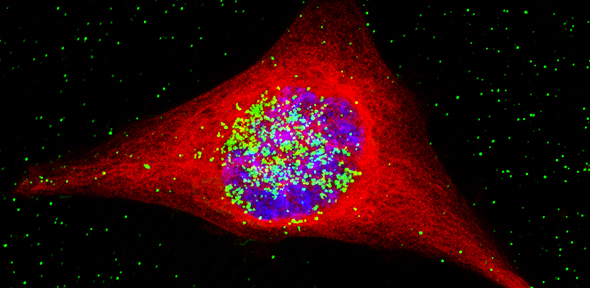
There is a reason glioblastoma has gone decades without a new approved drug. It is not that scientists haven’t tried. It is that the brain, in its infinite wisdom, has constructed a wall so effective that even the therapeutics meant to save it can’t get through.
The blood-brain barrier does exactly what the name suggests. It keeps the brain sealed off from the body’s circulatory chaos — toxins, pathogens, and, somewhat inconveniently, most drugs we’d like to deliver. For a tumour sitting inside that fortress, this creates an almost circular problem: the organ that needs treating is the one best defended against treatment.
A clinical trial published in Science Translational Medicine in 2019 suggested a possible way around this. The vehicle in question: spherical nucleic acids, or SNAs.
What Is an SNA, Exactly?
Think of a small, dense core — in this case, gold — wrapped in a dense shell of genetic material arranged radially outward. The structure resembles, as one of the researchers put it, a Koosh ball. (The 1980s toy reference stands. It works.)
The geometry is the point. Traditional linear strands of nucleic acid are quickly recognised and degraded by the body. Arranged in this tight, spherical configuration, they behave differently — they’re more stable, they enter cells more readily, and critically, particles of this size have been shown to cross the blood-brain barrier in a way that conventional drugs simply cannot.
The SNA platform was first described by Chad Mirkin at Northwestern University in 1996. The drug NU-0129 represents what happens when that foundational chemistry eventually meets a clinical problem.
What the Trial Found
Eight patients with recurrent glioblastoma received NU-0129 intravenously before undergoing surgery. The goals were modest and appropriate for a first-in-human study: establish safety, confirm that the drug actually reached the tumour, and look for signs of biological activity.
All three boxes were ticked. The drug was tolerated, it reached the tumour tissue, and analysis of post-treatment samples showed markers consistent with the drug’s intended mechanism — in this case, silencing a gene called Bcl2L12, which helps glioblastoma cells evade programmed death.
To be clear: this is not a cure. Eight patients, lower doses, no survival endpoint. What it is, is proof of concept — and in translational medicine, that matters enormously. Getting a novel nanoparticle drug past the blood-brain barrier and into tumour tissue in a human being is not a small thing.
Why It’s Worth Paying Attention To
The implications extend well beyond glioblastoma. The blood-brain barrier is an obstacle in Parkinson’s disease, Alzheimer’s disease, neuroinflammatory conditions — anywhere the brain needs therapeutic access. Demonstrating that SNAs can reach their target safely opens a line of inquiry that isn’t tumour-specific.
The next phase of research is focused on iterating on the core and shell — moving beyond gold toward compounds better suited for clinical development. Whether NU-0129 or a successor eventually makes it through Phase II and beyond remains to be seen. That’s how drug development works: slowly, with many more questions than answers.
But the door, at least, appears to be open.
Sources
- Kumthekar, P. et al. (2021). A first-in-human phase 0 clinical study of RNA interference-based spherical nucleic acids in patients with recurrent glioblastoma. Science Translational Medicine. doi.org/10.1126/scitranslmed.abb3945
- Mirkin, C.A. et al. (1996). A DNA-based method for rationally assembling nanoparticles into macroscopic materials. Nature. doi.org/10.1038/382607a0
- Jensen, S.A. et al. (2013). Spherical nucleic acid nanoparticle conjugates as an RNAi-based therapy for glioblastoma. Science Translational Medicine. doi.org/10.1126/scitranslmed.3006839
- International Institute for Nanotechnology, Northwestern University — iin.northwestern.edu
- National Cancer Institute — Glioblastoma information: cancer.gov

