Bladder cancer has an unfair reputation for being survivable — which it often is, when caught early. The less-discussed part is what “early” actually looks like in practice: roughly 85,000 people are diagnosed in the US each year, and more than half experience recurrence within five years. That means a lot of surveillance, a lot of cystoscopies, and a disease that quietly holds one of the highest lifetime treatment costs of any cancer. Not because it’s always aggressive, but because it keeps coming back, and you have to keep checking.
The current standard for monitoring recurrence relies heavily on urinalysis — looking for telltale biomarkers that tumour cells release into urine. It’s a reasonable idea in theory. In practice, by the time a biomarker reaches your urine sample, it’s been diluted, partially degraded, and possibly already cleared. You’re detecting a whisper of a signal that was much louder at the source.
A team at MIT, led by chemical engineering professor Michael Strano, decided to go to the source.
Sensors Inside the Bladder
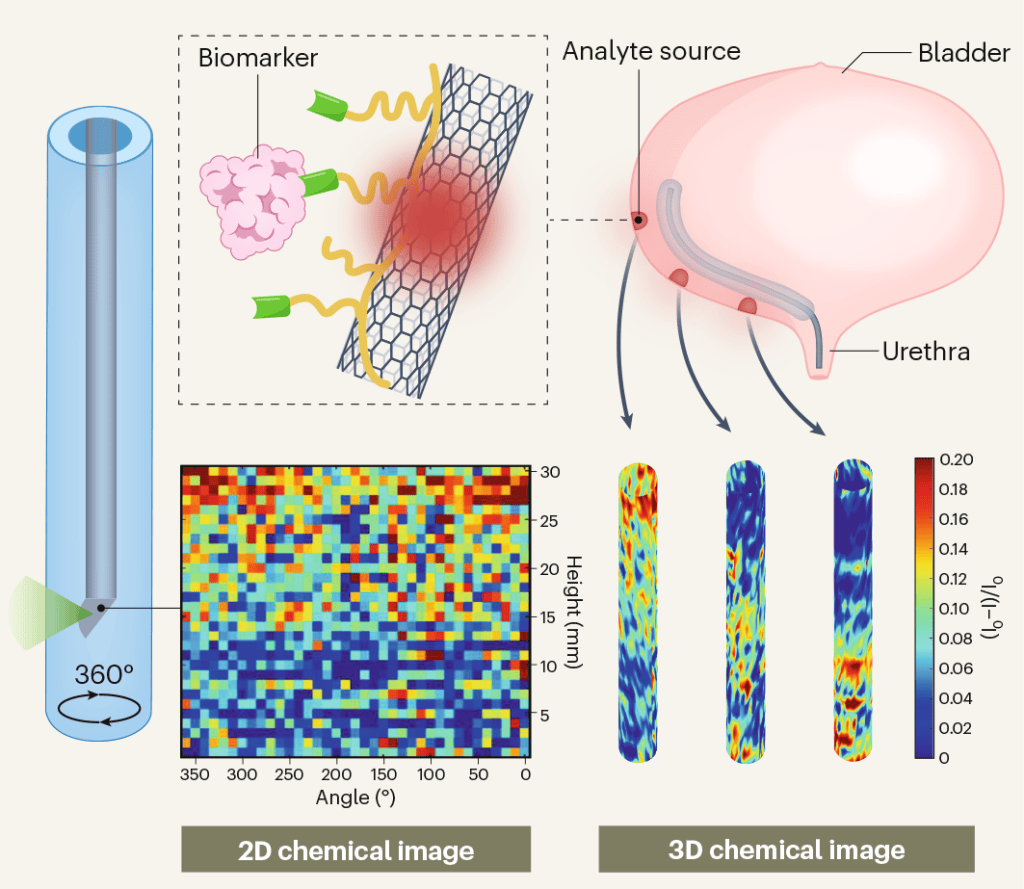
Their approach, published in Nature Nanotechnology in June 2025, involves a catheter coated with carbon nanotube sensors — tiny molecular detectors engineered to recognise a specific bladder cancer biomarker called NMP-22, which is FDA-approved for exactly this kind of detection. Rather than waiting for NMP-22 to drift into urine, the device looks for it directly inside the bladder wall, where the signal is far stronger.
The catheter also contains a miniature rotating ball lens that emits laser light and collects fluorescent signals from the nanotubes when they interact with the target molecule. The result is something genuinely clever: a three-dimensional chemical image of where the biomarker is coming from — not just whether it’s present, but roughly where.
“It’s like a camera for molecules instead of light,” Strano said. Which is, honestly, a very good way to put it.
In experimental testing, the platform achieved a 182-fold signal enhancement compared with standard biofluid sampling. The researchers also demonstrated detection at distances up to two centimetres from a biomarker source — meaning the sensor can pick up signals from tumours that haven’t yet broken through the surface of the bladder wall. Tumours that wouldn’t be visible under a camera. Tumours that, currently, would simply go undetected until they grew larger.
Carbon Nanotubes as Synthetic Antibodies
The nanotube technology here isn’t new — Strano’s lab has spent over a decade developing sensors that can detect specific molecules by coating nanotubes with polymers that act as synthetic antibodies. Different polymer coating, different target. Previous versions have detected hydrogen peroxide, riboflavin, and viral proteins. Bladder cancer is the latest application, and the catheter format is well-suited to a disease that already involves regular catheter-based procedures.
The study also notes that the underlying platform isn’t limited to bladder cancer. Swap the nanotube coating, and the same device could potentially be adapted for other cancers, or diseases of the cardiovascular or gastrointestinal systems.
What This Actually Means
This is early-stage research — porcine bladder models, cell line testing, no human trials yet. The path to clinical use involves miniaturisation, integration with existing cystoscopes, and considerably more validation. None of that is small work.
But the core idea is compelling: rather than waiting for evidence of cancer to travel through the body and degrade en route, you detect it at the site where it’s actually happening. Earlier detection, more localised information, potentially better outcomes.
Sometimes the most useful thing a nanotechnology can do is simply go where the signal is strongest.
Sources
- Yim, W. et al. (2025). Nature Nanotechnology — Nanotube-based chemical imaging catheter for bladder cancer detection. [nature.com/nanotech]
- American Cancer Society — Bladder Cancer Statistics. [cancer.org]
- MIT News — “Nanosensor catheter can detect bladder cancer recurrence.” [news.mit.edu]
- FDA — NMP-22 BladderChek Test approval information. [fda.gov]
- Strano Research Group, MIT Department of Chemical Engineering. [strano.mit.edu]

